


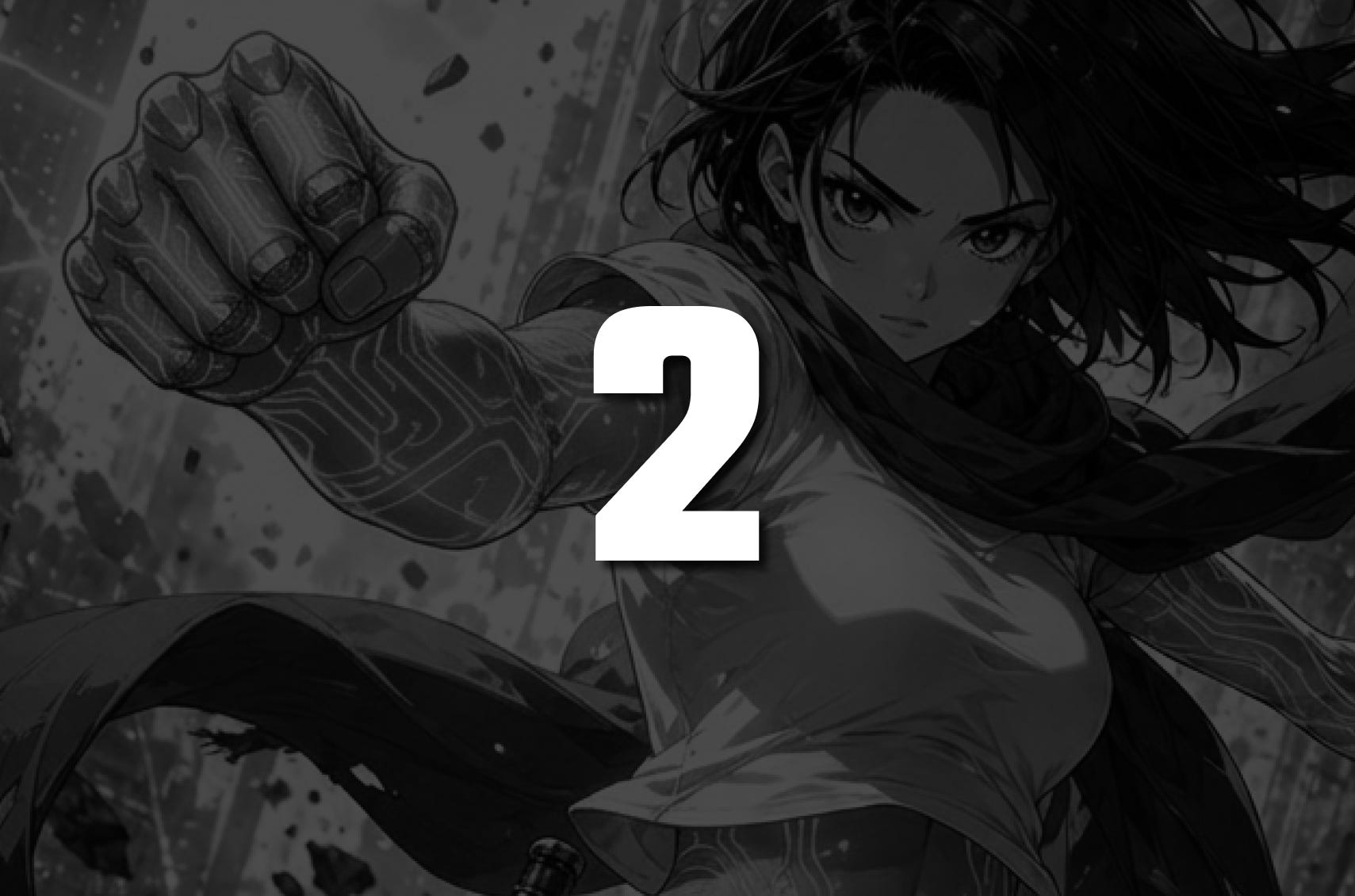
I needed a shower. My skin was starting to itch as I entered tower 4. But the smell of Gogo Zola’s noodles, something with protein and actual spice hit me and my stomach grumbled.
Biological contamination levels elevated. Caloric intake below optimal threshold. Virgil alerted me.
“Fine. Let’s eat first.”
Her kitchen sat in a converted maintenance alcove three junctions from my pod. She had always been there, acting like a grandma for everyone there. She knew everyone and had opinions, strong one on everything that happened in the towers of the habitat.
The alcove fit maybe eight people standing, four sitting. I dropped my pack by the counter and set the cargo net carry between my feet where I could feel it. It was late, the place was mostly empty. Nico Bulba was at the far counter with a bowl he’d pushed aside and a feed scrolling across his HUD, his eyes doing the unfocused drift of someone reading fast.
“Beatrix,” he looked up. Twenty-two, pale skin like his father, broad-shouldered in a way that hadn’t finished filling out yet. Hair still sleep-rumpled at the crown. “You look like you crawled out of a recycler.” His nose wrinkled.
“Vacuum’s a harsh beauty regimen.” I said.
Gogo Zola materialized from behind the partition. She was a large woman who moved through her own kitchen like it was two sizes too small for her, which it was. Sixty-something, gray-white hair pulled back tight, arms that had been lifting things for decades. She looked at me, made a sound that was not quite disapproval and not quite welcome, and turned back to the heating unit.
“You haven’t eaten well, Aliger,” she said. “The noodles are almost gone.”
“I’ve missed you too, Gogo.”
“Mmffhh.” Gogo Zola set a bowl in front of me without asking. “Prove it. Eat your noodles.” The broth was real. I took a deep breath to smell the scent. Gogo Zola’s face didn’t change, the woman was a deadly poker player. But her mood shifted visibly as I started eating, the slight relaxation around her eyes that was the closest she came to approval.
“You see the feeds?” Nico had turned on his stool, feed still up in his peripheral. His knee was bouncing. “Charon. They’re saying Charon is coming back.”
The broth worked through me like something I’d forgotten my body could do. “What do you mean, back?”
“That he’s registered. Or close to it. Someone pulled a shadow entry from the Grind’s pre-cert system and the specs match.” He leaned forward. “Imagine that. Charon. Back in the Grind.”
I knew the name. Everyone did. Charon was a staple of the Grind for as long as I remember. Dante was six when he got his autograph. Everyone was shocked when Jon Kane defeated him and broke every bone in Charon’s body before the Arbiter decreed Mercy. He was assumed dead. And now he was back.
But I didn’t share Nico’s enthusiasm. I was worried about something else.
“I hear you will try to qualify in the Culling,” I said.
His face split. “They are paying a million now. To the champ.” He raised his right arm. It had two black thick lines. It was the mark of those who had signed to the Grind. No way he could back down now.
“To the champ,” I agreed. I didn't look at the two black lines again. Thousands went into the Culling every year, trying to qualify. Most didn't come back out.
“Isithutha.” Gogo Zola said, directed at the ceiling, which was her standard address for opinions she wanted heard but not argued with. Virgil translated instantly. Fool.
“What?” Nico said.
“She’s not talking to you,” I said.
“She’s talking about me.”
“Probably.” I finished the broth, turned the bowl. “You going alone?”
“For now. Might recruit a team at the staging zone.”
I reached into my pack. My fingers brushed the module’s casing first, the cold of it, the pulse I could feel even through the carry. Two hundred fifty credits, Bodhi said. And it seemed like good advice. I moved past it. This could actually help him. The military medikit was underneath. I set it on the counter between us.
Nico looked at it. “What—”
“It’s sealed, it’s clean, it’s got trauma foam and coagulant. Carry it somewhere you can reach with your off hand.”
He picked it up. The bounce in his knee stopped while he read the spec panel on the back. Real attention, the kind he hadn’t been giving the feed. “What’s this? Are you stealing OMEGA convoys, now?”
“Yes. Went to Old Earth just to get it.”
“How much—”
“Just take it, Nico.”
He held it a moment, then tucked it into his jacket with the care of someone who understood what he was holding.
“Investing in the future champ.” He grinned. “Smart move, scav.”
I picked up my pack and the carry. Gogo Zola was watching me from the other side of the partition, both hands wrapped around her own bowl. Her expression was the one she used when she’d already decided something about a situation and was waiting to see if anyone else caught up.
I didn’t look at her long. Sent her the five credits for the noodles.
“Great food, Gogo,” I said. “Thanks.”
“You need to eat better, Aliger.” She made the sound again. “Too much muscle and no curves.”
Gods, I need a shower. I turned toward the door. The carry bumped my hip. My hand reached it, to make sure it’s there. It is. Cold and waiting.
Gogo looked at me. My hand moved away as a reflex. Her face didn’t change, but something behind her eyes did.
“Aliger,” she said. The voice she uses when she mad with one of her descendants. “You come back when you’re hungry. You hear?.”
I couldn’t answer that. I nodded once and went. The module hit my hip again on the way out. I didn’t shift it. I just walked.
The shower lasted sixty glorious seconds. Finally clean after five weeks.
I stood in the middle of my pod in a dry shirt with my hair dripping cold down my back, and the only thing touching my skin was air. The pod grumbled awake around me, systems clicking back on one by one after five weeks dark. Twelve square meters, a sleeping platform, a work table, the salvage rack that took up one entire wall. Five weeks of absence had settled on everything as fine gray dust and stale air.
My boots went by the door, toes out, the way Dante used to line his up when we were kids, like the floor was a chalk line and he didn’t want to cross it crooked. My tools were where I’d left them. Salvage kit at the door, diagnostic scanner on the second shelf, plasma cutter cradled below it. Frequency of use. Bodhi’s organization, absorbed without being taught.
The photo was on the shelf above the sleeping platform. Me, eight, missing a tooth. Dante, gap-toothed too, holding my hand up like I’d won something. Mom behind us, one hand on each of our shoulders, looking at the camera like she didn’t trust it. One of the good days, when the station’s lights were all working and we looked like people who lived somewhere worth living. I checked it the way I always did coming back: fast enough to confirm it hadn’t gone anywhere.
The scarf was next to the photo, folded into itself the way Mom used to fold it. I shook it out. Red, faded at the creases from years of the same fold. I held it to my face and breathed in, and for half a second there was lavender, the cheap soap that never bothered Mom’s hands. Then it was just fabric and recycled air. I wrapped it around my neck.
The carry came last. I opened the pack and set the module on the worktable.
The black circuitry pulsed in slow, even intervals. I lifted it out and looked around the pod for somewhere logical to put it. I carried it to the shelving unit instead and set it down on the second shelf, in the gap where my signal booster used to sit before I traded it to Bodhi for parts I never used. The module fit the space almost exactly.
The star pulsed once, harder, a flare and gone, like it had noticed being moved.
Confirmed, Virgil said. Power signature, momentary. Source unidentified.
The scanner sat on the same shelf, an arm’s length away. I looked at it longer than I needed to.
Then I looked at the rest of the shelf. The rest of the pod. Five weeks of gray dust on everything, and the module sitting in the middle of it without a speck anywhere, black and clean like it had been delivered that morning, making everything else look cheap.
I found a cleaning cloth under the sink and started on the salvage rack.
Incoming call, Virgil announced. Dante Aliger.
I set the cleaning cloth on the salvage rack and watched the call tag until it turned green.
The pod didn’t go anywhere. The rack stayed solid under my hand, the worktable a step to my left, the deck cool through my socks. But the air in the middle of the room thickened and resolved, and the far wall went pale blue and clean in the way that cost money. A bed took shape where there hadn’t been a bed, and Dante was on it, propped against pillows that didn’t exist in my pod and never would.
I crossed to the sleeping platform, the rack and worktable behind me now, Dante’s bed across the room to my left, and sat on the edge of it, the photo on the shelf just above my head.
He was pale and stretched too thin under the medbay’s sterile blue glow, dark hair grown in patchy around the neural ports at his temples, too many lines on a forehead that was barely eighteen.
“You look like you lost a fight with a recycling compactor,” he said, trying the old trick to make me smile. I had to remember to do it.
“Won, actually. The compactor’s in pieces. I kept the shiny bits.” He didn’t laugh. His eyes had already gone past me, to something on his own screen.
“They sent the final notice. The final-final one. With, like, embossed lettering.”
A second presence resolved near the foot of the bed, full body, like she’d stepped into frame mid-stride. Dr. Velsen, OmniMed: perfect teeth, expensive Humanware with ocular implants that probably came with a stock-ticker overlay, the kind of symmetrical, calibrated beauty that screamed never missed a credit payment.
“Good evening, Miss Aliger. I’m here to clarify the terms and timeline for the Tier IV intervention.”
“Just say the number,” I cut in.
“The Neural Regeneration Trial represents the absolute pinnacle of…”
“The. Number.”
Dr. Velsen’s professional smile glitched for a nanosecond. “Eight hundred forty-seven thousand, two hundred ninety credits. A non-refundable deposit of forty thousand credits is required within ten days to secure the treatment slot and initiate synthesis of the proprietary nano-regenerants. The full balance is due in thirty days to secure the slot in this year’s batch.”
The number meant nothing to me on its own. Numbers never did. Virgil ran it against our current account, against six months of salvage, against every job I’d taken since I was sixteen. The number didn’t move. It just sat there, and nothing I could throw at it made a dent.
847,290 credits.
“And if I... if we can’t make the deposit?” I asked. Dr. Velsen waited for her humanware to translate my question.
“Then we’d move Dante into our comfort program. It’s a very good program. Pain management, full mobility support, accommodations for family to stay close.” She said it the way she’d said it a hundred times, the way people like her talk to poor people. We stop. We make him comfortable. You come say goodbye in a nice room.
Dante’s face didn’t move. He’d heard this before. That was the worst part, that he’d had time to get used to it.
I killed the call with the doctor. She froze mid-motion, hand still lifted toward a tablet that wasn’t there, and then she was gone, the space where she’d been standing empty and pale blue, the same as the wall.
Dante looked at the spot where she’d been. Then at me. The pillows behind him sank as his shoulders dropped, the performance going out of him all at once.
“Eight hundred forty-seven thousand,” I said, the number a sour taste on my tongue. “In thirty days.”
“Don’t.” Dante’s voice was louder than before. “I can see you doing the math. I can see you adding up every bolt and scrap of conduit we don’t own and coming up with a total so impossible it only has one insane answer.”
“I will fix it.” Again.
“Yeah? What? You gonna sell the pod? We’d get maybe twenty grand… Damn.” He ran a thumb over the neural port at his temple, a nervous tic that made my skin crawl. “It’s impossible. It’s… like, the only place to get that kind of money is the Grind.” He let out a short, breathy laugh that held no humor. “It’s crazy.”
The Grind.
The insane, terrible math clicked together. The show Bodhi had called a meat grinder. The tournament Dante used to watch with stars in his eyes, reciting fighter stats and aug-loadouts like they were religious texts, yelling at the screen as if the gladiators could hear him. The thing my mother feared the most.
They are paying a million now. To the champ.
“It’s crazy,” I said. I barely controlled the urge to turn and look at the module.
“Bix, listen. Really listen.” He leaned closer. “I know you. I know you are thinking of finding a wreck that will solve this. Or joining a Corporation. Or, even worse, a Clan.”
He paused, seized by a violent, hacking cough. “I’d rather die as myself than live knowing you destroyed yourself to buy me a few more months. Promise me you won’t turn into somebody else.”
The bed was three meters away and not really there, and I reached for his arm anyway. My hand passed through the edge of the blanket, a faint pressure where there should have been weight, the system’s best guess at touch.
“I’ll still be me when this is over,” I said.
I built it myself, on the spot, to fit exactly what I needed it to fit. And I believed every word of it.
His vitals are dropping toward baseline, Virgil said.
“I have to go,” I said, cutting off the protest forming on his lips. “I will fix it.”
“Bix…”
“Love you.”
The medbay thinned, the pale blue wall fading back into the gray of my salvage rack, the bed dissolving until the floor was just floor again. My pod came back around me, smaller than it had been five minutes ago, the way it always was after.
The module sat on the shelf where I’d left it, pulsing the same slow rhythm. The scarf was still around my neck, smelling like nothing at all.
I sat there a minute. Then I got up, picked the cloth back off the rack, and went back to it.
The rack still had four bins of salvage from the walk back, things I’d been too tired to sort five weeks ago. I dragged the first bin out and started.
Ferrous in one pile, composite in another, anything with a working chip set aside to test later. The way Mom taught us.
I worked fast, I wasn’t trying to be careful. Crates dragged instead of lifted, stuck latches forced instead of worked loose. By the time the last bin was sorted, my neck was damp under the scarf and I’d run out of excuses to stay on this side of the room.
The worktable was next. I wiped it down, moved a dead plasma torch to the tool rack, straightened the marking pens by color because my hands needed something to do. My PADD was still where I’d dropped it, screen dark, a number sitting on the roster icon I didn’t let myself read. I picked it up, set it face-down on the far end of the table, and didn’t open it.
Incoming call, Virgil announced. Bodhi.
I turned my arm so the light faced the floor and let it ring.
The recruiting reel was still running on the wall panel by the door, three ships turning slow against a painted nebula, the scrolling font asking nicely if I wanted to be something bigger than a scavenger. I’d watched it a hundred times. I knew the pitch by heart. I wiped the dust off the frame and left the screen on.
There was nothing left to clean except the shelf.
I turned around. The module sitting in the dust-rectangle where my signal booster used to be. Black casing, no seams, the twelve-point star catching the light. The scanner sat next to it, an arm’s length away, right where I’d left it.
I touched the scarf without meaning to. The fabric was warm from my neck, the lavender long gone. My fingers found the frayed edge, the friction burn I’d never trimmed, and held there for a second.
I picked the module off the shelf and crossed to the sleeping platform. Cleared a space. Lined up my tools. Swabbed the surfaces. Then I picked up the scanner. The charge was full. Good.
SCANNING. I waited for a response.
UNAUTHORIZED SCAN DETECTED.
My hand pulled the scanner back like it had bitten me. The star on the module’s casing flared, brighter than before, and stayed lit. Light washed across the shelf, across my hand, across the scanner’s display, and then resolved into text I hadn’t seen before, like it had been waiting for a reason to show itself.
SYSTEM COMPATIBILITY ANALYSIS
A number started climbing underneath it. Forty. Sixty. Eighty.
I didn’t move. Virgil didn’t say anything either, which was its own kind of answer.
100%.
INITIATE INSTALLATION [Y/N]
Warning, Virgil said. I have no record of this unit. No manufacturer, no model, nothing in any database I can reach. I can’t tell you what it does or whether it can be stopped once it starts.
“It’s legit, right? OMEGA?”
That’s all the data I have. No installation has run this configuration to completion before.
I looked at the tiny window. Towers two and three, rusted metal catching the sun’s orange rays. Then the walls. The rack on one side, the shelving unit on the other, the sleeping platform between them, the whole pod no more than four steps end to end.
Then I checked the old cranial jack for continuity, then checked it again. Tied my hair back and sat with the module between my knees, small and black as a coffin.
I pressed Y.
The interface ports lined up with my Humanware like they’d been built for it. Bodhi’s voice, from some other conversation: military hardware, made to plug into anything. Soldiers were just people with better gear and worse choices.
Like me.
I pressed my forehead to the casing. The circuitry pulsed against my skin, patient. I set the connector against the base of my skull. The jack bit cold, familiar. One breath. Two.
I pushed the connector home.
Pain came fast and clean. The pod vanished like silk pulled from under dishes. For one heartbeat there was nothing to fall past and nothing to fall toward, just a held breath let go all at once, gravity arriving from the inside instead of from below.
Then the dark around me stopped being empty.
Above me, or what had been above a second ago, the black thinned into something pale and endless, lit from no direction I could find. Small shapes moved through it in buzzing formation, turning together, too far off to be anything but shapes. First option: Dronemancer. Nothing to hit, nothing to grab, nothing for anything to reach.
To the side, corridors of light branched and rebranched, paths glowing where walls should have been, the whole maze folding back on itself until depth stopped meaning anything. Second option: Neuromancer. No edges to corner, no shape to pin down, nowhere that stayed anywhere long enough to be found.
Below me, the dark thickened instead of thinning, and heat came up to meet me before anything else did. Hot metal, warped flesh, claws and scales glowing the way metal glows when it’s too hot to touch, something enormous breathing slow and patient, somewhere down in it, waiting. Third option: Dreadnought. A body too big to overlook, too heavy to be outweighed, built to take a hit and give it back doubled.
“Yes.”
I was already falling toward it. The other doorways faded like smoke.
Cold took me first, every nerve at once, like the air had been pulled out of a room I was still standing in. Then heat, underneath it, in the same places, my blood running two temperatures that refused to mix. Something moved under my skin, threading itself through muscle and bone, lattice by lattice, a million small machines weaving carbon fiber into the marrow of me.
Something that felt armor the way other things felt skin.
Something that hit like a bulkhead deciding to move.
Something that wouldn’t recognize the girl who made that promise.
Lavender hit me, thick enough to taste, filling my throat and sinuses and sitting heavy on the back of my tongue. It didn’t fade.
Your hands are for building, Bix. Promise me. Promise you’ll stop.
I promised. “I won’t fight.”
Warni— Virgil’s voice drowned in the bubbling muck, like sugar in hot oil. Something viscous flowed relentless into the space where he’d been. It spoke low, each word landing with weight behind it, a voice that didn’t need volume because it had already won.
Welcome, Operator.
Then darkness, all the way down, and this time I didn’t fall into it. I was already there.
